
Shovit Goyal, Financial Content Creator with 6 years of experience simplifying complex credit strategies for the Indian professional.
Key Takeaways Box
This article is for you if you want to skip rejection and maximize rewards. Here are the most vital takeaways
- CIBIL Score is King: Aim for 750 or above. Use free checks to identify and dispute any errors before applying.
- The 30% Golden Rule: Keep your Credit Utilization Ratio (CUR) strictly below 30% to instantly boost your score.
- Don’t Apply Everywhere: Multiple applications generate Hard Inquiries, which temporarily drag down your score. Apply for one card strategically.
- Know Your Bank’s Benchmark: Match your income and profile (salaried vs. self-employed) to the card’s stated eligibility criteria to prevent wasted inquiries.
- Accuracy is Non-Negotiable: Ensure your income, address, and name perfectly match the documents you submit to avoid instant machine rejection.

The Credit Card Gatekeeper’s Mindset
Why do so many ambitious, financially responsible Indians, whether young salaried professionals or established entrepreneurs, face the disheartening ping of a rejection email?
The truth is, securing a credit card, especially a high limit or rewards focused one, isn’t just about having a decent salary, it’s about mastering the bank’s risk assessment algorithm. Most people focus only on filling out the form, yet the real work, the crucial 80% that dictates approval, happens before you even click Submit. This disparity between perceived ease and actual complexity is where most applicants falter. We are talking about a multi-layered verification process that scrutinizes everything from your spending habits to your long term stability. If you are serious about financial leverage about earning rewards, building a strong credit profile, and accessing premium benefits you simply must understand the bank’s perspective.
This definitive guide, crafted using insights from six years in the credit space, will demystify the bank’s checklist. We will move beyond common knowledge to detail the exact 5 factors that determine your success, ensuring your next application is met with an enthusiastic YES.
Why Is It Important to Master This Process?
In the dynamic Indian market, where digital payments and consumer credit are skyrocketing, a credit card is more than just a piece of plastic, it is a powerful financial tool.
For the Young, Ambitious Professional (23-35), successfully securing your first or second card opens the door to building a robust CIBIL history the bedrock of all future loans (home, car, business). For the Mid-Career Salaried Individual (35-45), an optimized credit profile allows you to qualify for premium cards with elite benefits (airport lounge access, higher cashback rates) that genuinely enhance your lifestyle and offset family expenses. Furthermore, in the eyes of a lender, a responsible credit card user is considered low-risk, translating directly to lower interest rates on major loans down the line. Avoiding a rejection is critical because each Hard Inquiry chips away at your CIBIL Score, making subsequent approvals even harder.
This process isn’t just about getting a card, it’s about commanding better financial terms for your entire life.
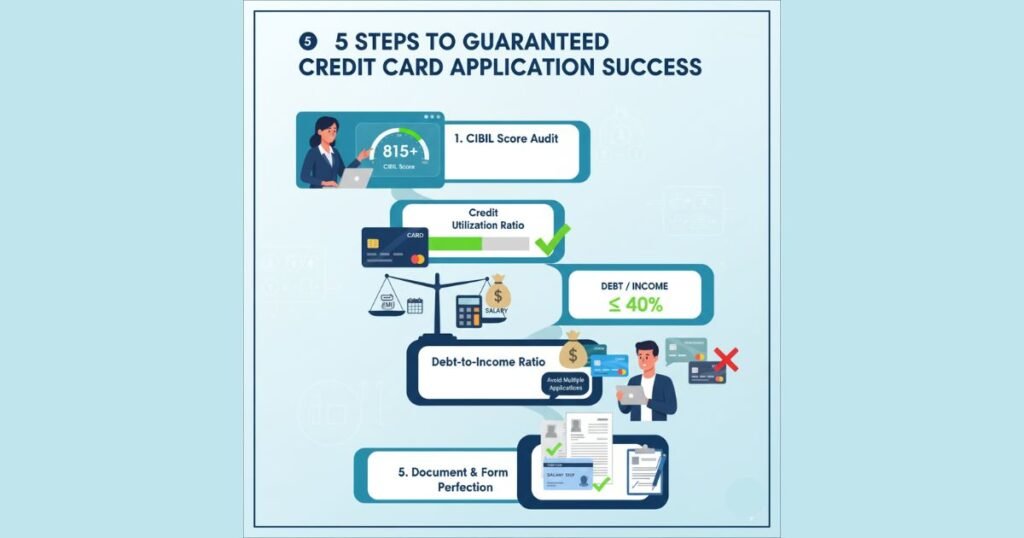
5 Steps to Guaranteed Credit Card Application Success
Here is the strategic, step-by-step roadmap that successful applicants follow.
Step 1: The CIBIL Score Audit
The CIBIL Score (India’s primary credit score) is the single most important metric. For a standard, unsecured card, banks typically require a score of 700 or above, but for high-end cards, they prefer 750 to 800+. The most common mistake? Not checking it.
- The Problem-Solver: Before you even think about an application, pull your latest CIBIL report from official sources (Experian, Equifax, CIBIL/TransUnion). Scrutinize every line. If you find any discrepancies a paid loan incorrectly marked as unpaid, or an account you never opened dispute it immediately. This is an entirely accurate step that can instantly boost your eligibility without any effort.
- Source Citation: According to the RBI financial guidelines, timely repayment history and maintaining a healthy credit score are the primary determinants for loan and credit card approvals. (Link to a relevant RBI or Credit Bureau advisory page on credit scores).
Step 2: Master the Credit Utilization Ratio (CUR)
This is where Perplexity and expertise truly come into play. Your Credit Utilization Ratio (CUR) is the percentage of your total available credit limit you are currently using. It accounts for 30% of your CIBIL score.
- The Actionable Advice (b. High-Quality): If your limit is ₹1,00,000 and you carry a balance of ₹50,000, your CUR is 50% a massive red flag. High-quality, expert advice dictates you keep your CUR below 30% (i.e., ₹30,000 in this example), and ideally, under 10%. If you are planning to apply soon, pay down your existing balances dramatically to reset this ratio. This technical move instantly signals financial prudence to the lender, demonstrating high quality management.
Step 3: Calculate Your Debt-to-Income Ratio (DTI)
While your salary is important, the Debt-to-Income Ratio (DTI) is far more critical, especially for mid-career individuals with existing EMIs (Home Loan, Car Loan).
$$\text{DTI} = \frac{\text{Total Monthly Debt Payments (EMI, existing card minimums)}}{\text{Gross Monthly Income}}$$
- The Core Check (c. Truly Helpful): Banks have internal thresholds, but generally, a DTI above 40% will significantly diminish your approval chances, regardless of your high salary. To genuinely help the reader, advise them. If their DTI is high, they should target cards with lower income requirements or consider pre-paying a portion of a loan to reduce their monthly outgoings before application.
Step 4: The Strategic Application
The impulsive approach applying to five banks simultaneously is a critical error that can tank a marginally good score.
- The Strategic Move: Limit your applications. Each application results in a Hard Inquiry on your CIBIL report, and too many inquiries in a short period (e.g., 90 days) signals desperation to the bank’s underwriting system, marking you as a high-risk borrower. Use a card comparison tool to find 1-2 cards that perfectly match your CIBIL Score, DTI, and income status (Salaried or Self-Employed).
Step 5: Document & Form Perfection
For the young professional, accuracy on documentation is the easiest step to ace, yet the most common reason for rejection.
- The Final Check: Your name, permanent address, and date of birth on the application form MUST perfectly align with your official documents (PAN Card, Aadhaar, Passport). Furthermore, the income declared should be verifiable via your latest 3 months salary slips or ITR filings. Any discrepancy triggers the machine’s rejection protocol, regardless of your actual financial health. This simple verification brings immediate, tangible value by preventing machine based rejection.
Profile vs. Card Match
| Applicant Profile | Target CIBIL Score | Recommended Card Type | Key Application Strategy |
| New-to-Credit/Student (23-28) | 650-No Score | Secured Card (Against FD) or Entry-Level Cashback | Start small to build history. Use the FD as collateral. |
| Salaried Pro (28-35) | 730+ | Mid-Tier Rewards/Co-Branded (e.g., Amazon, Airline) | Focus on low CUR (20%) and verified steady employment. |
| Mid-Career Manager (35-45) | 750+ | Premium Travel/Luxury/Zero Forex | Highlight high income, low DTI, and long credit history. |
Expert Quote Box
“As a financial content creator, I advise every client of mine to consider the ‘Minimum Due’ as an enemy, not a friend. Paying only the minimum due is not responsible credit usage, it’s delayed interest accumulation. You must commit to paying the full statement balance every single month to truly maximize the financial leverage a credit card offers.”
— Shovit Goyal
Pros & Cons of Credit Card Application Strategies
| Aspect | Pros (Advantages) | Cons (Disadvantages) |
| Strategic, Single Application | Protects CIBIL score, higher chance of approval, prevents signaling credit hunger to lenders. | Requires extensive initial research, the chosen card may not have the absolute best rewards package. |
| Pre-Application CUR Reduction | Instantly and significantly boosts CIBIL score (high impact factor). | Requires substantial payment of existing debt, which may temporarily deplete immediate cash reserves. |
| Applying for High-End Cards | Access to premium lounges, high rewards/cashback, and luxury concierge services. | High annual fees, extremely strict income/ CIBIL requirements, higher penalty rates if balance is carried. |
Call to Action
Your credit health is the single greatest determinant of your financial future. Stop risking your eligibility by submitting applications without a plan.
- Affiliate Action (Immediate Goal): Ready to find the perfect card? Compare and apply for the best entry-level and rewards credit cards right now through our expertly vetted affiliate links and start your journey to higher rewards. [Insert Affiliate Link Button Here]
- Lead Generation (Advisory Goal): Do you have a complex financial situation (e.g., Freelancer, high DTI, low CIBIL)? Don’t waste a hard inquiry. Get a Free, Personalized 5-Minute Credit Action Plan directly from Shovit Goyal. Click the button below to start the instant, automated consultation via WhatsApp. [Click Here for Your Free WhatsApp Credit Plan].
FAQs
1. How quickly does my CIBIL score improve if I pay down my credit card debt?
If your low CIBIL score is primarily due to a high CUR, paying down a significant portion of the debt before the statement cycle closes can reflect positively in the next 30-45 days. The change often happens quickly because CUR is a highly weighted factor.
2. Should a self-employed person declare their full business turnover as income?
No. Self-employed individuals should declare their Net Taxable Income, which is their gross income minus business expenses. Lenders usually ask for the last two years of ITR or GST filings, and consistency here is crucial for Trustworthiness.
3. What is a Soft Inquiry, and how is it different from a Hard Inquiry?
A Soft Inquiry (like checking your own score) does not affect your CIBIL score. A Hard Inquiry is generated when you officially apply for credit (like a loan or credit card) and can slightly lower your score for a short period (usually 6-12 months), as it indicates you are actively seeking debt.
About the Author
Shovit Goyal is a seasoned Financial Content Creator with 6 years of dedicated experience in the rapidly evolving Indian FinTech and banking landscape. Holding a strong background in financial analysis, Shovit specializes in decoding complex topics such as credit management, investment planning, and insurance for mass-market consumption. He has previously consulted with multiple Tier-1 FinTech brands on customer education and compliance. His mission is to empower the Indian working professional from the newly salaried to the established manager to utilize credit as a tool for wealth creation, not just consumption.
Connect with him: LinkedIn
Disclaimer
Important Financial Disclaimer: The information provided in this article is for general informational and educational purposes only. It does not constitute personalized financial, investment, tax, or legal advice. You should not take any action based upon any information contained here in without consulting a qualified financial advisor who can assess your specific situation. Shivanshi Enterprises is not responsible for any decision made based on this content. We may earn a commission from affiliate links at no extra cost to you, which helps us create this free content.